
Route Planner Basics
How to build a driving route in Austria
A good Austrian route is built in layers, not typed into one box and trusted. You choose the corridor, decide whether motorway or ordinary road suits each leg, estimate time with honest assumptions, and check the constraints that could break the plan.
This page walks through that method step by step for car drivers. It stays useful even when a specific road or price changes, because it is about how to decide — not what one app said this morning.
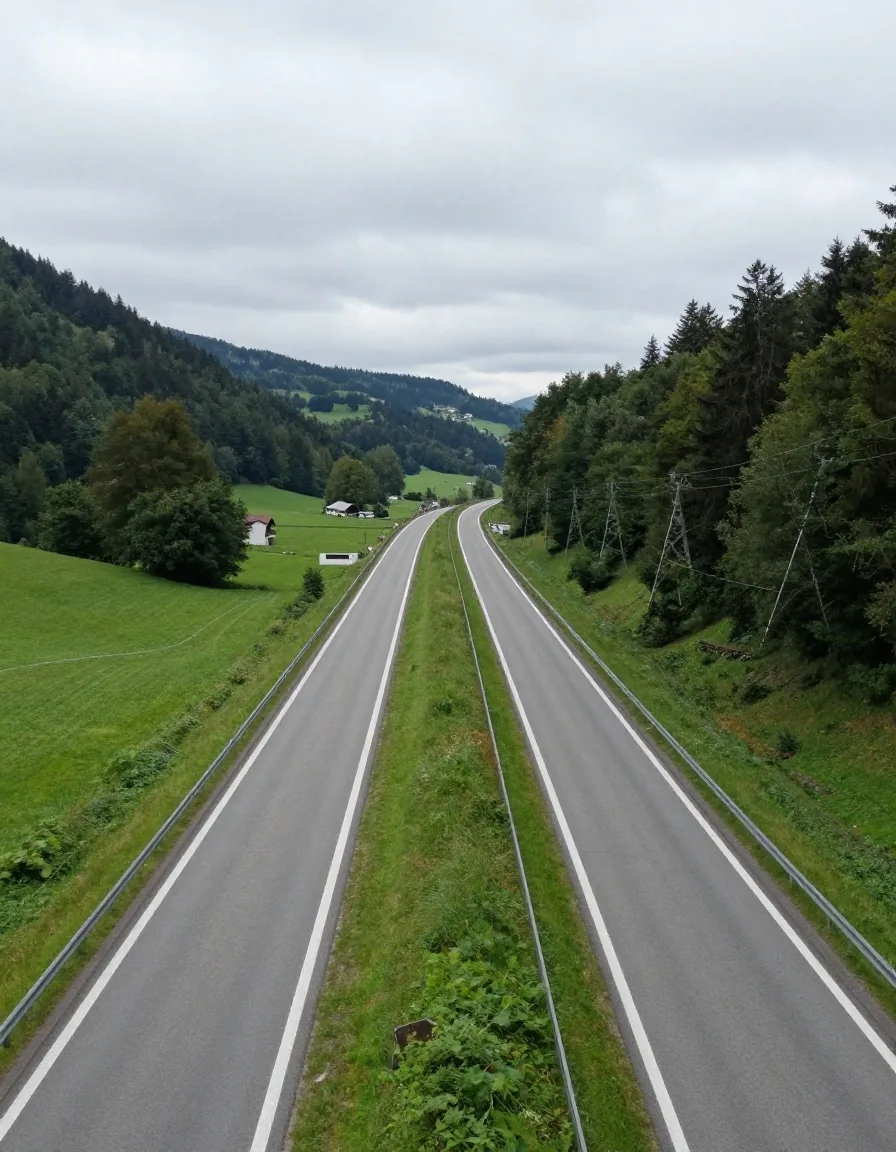
Plate — corridor from above
East to west reading
Start with the job the drive has to do
Before corridors or times, decide what the drive is for. A business trip from Vienna to Linz has different priorities than a family holiday crossing to Carinthia. One wants the fastest reliable line; the other may accept a slower road for a better drive.
Write down your fixed points: where you start, where you must be, and by when. Everything else on this page is a way to serve those points. Routes that ignore the purpose of the trip tend to be either needlessly slow or needlessly stressful.
Be concrete. Note passengers, luggage, arrival deadlines, and whether you can arrive tired or need to arrive fresh. A driver heading to a morning meeting will plan stops and departure time differently from a driver with two days and no fixed check-in. If you travel with children or older passengers, shorter legs with planned breaks matter more than a theoretically faster line that leaves everyone exhausted.
Three lines to write before you open a map
- Start, must-stop, and final destination — with the time you must arrive.
- What a good arrival looks like: fastest, calmest, or most scenic.
- What you will not accept: night mountain driving, city centre parking, or back-to-back long legs.
Direction first
Choose a corridor before you choose a road
Austria's long-distance driving is organised around a few motorway corridors. Pick the corridor that runs in your direction first, then the specific roads that feed into it. Choosing a corridor first keeps your route coherent and makes it easy to find a sensible alternative if one section is closed.
For an east-west trip, the western motorway between Vienna and Salzburg is the usual spine. For the south, the route toward Villach and the climb through the Tauern range carries the traffic. Once the corridor is fixed, access roads become simple: they either join it cleanly or they do not. The motorway corridors page describes what each one connects. See the motorway corridors.
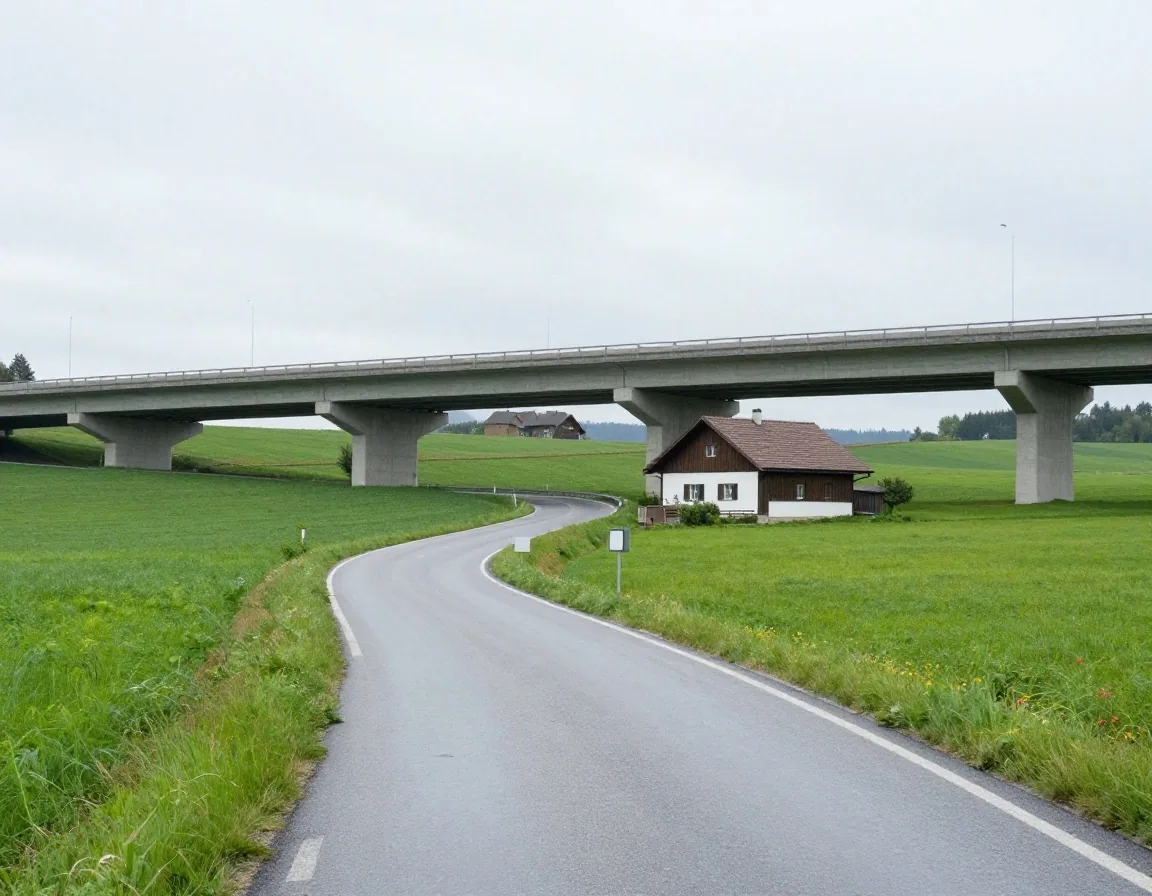
Motorway or ordinary road: the real trade-off
Motorways are faster and simpler, but they require a vignette and can be crowded or dull. Ordinary roads cost no vignette on most sections, show you more of the country, and often suit shorter legs better.
The trade-off is not just time. Ordinary roads add junctions, towns and speed changes, which raise the effort of driving and the chance of a wrong turn. For a 40 km leg, an ordinary road is usually fine. For 400 km, the motorway almost always wins unless you have deliberately chosen a scenic day. Decide per leg, not for the whole trip.
If you split the decision, a common pattern works well: motorway for the long middle, ordinary road for the first and last stretch where villages and arrival streets matter. Compare scenic and fastest routes.
Honest numbers
Estimate driving time with named assumptions
Any time estimate is a claim about conditions, so make the assumptions visible. Note the corridor, the time of day you will drive, whether you stop, and whether the route includes a pass or tunnel with restrictions.
Then add realistic buffers: city approaches at peak hours, mountain gradients, and one proper break on a long drive. A route that quotes a single clean number is hiding the part that matters. If you build the estimate yourself, you can see exactly where it might be wrong and plan around it.
A practical way to do this for route planner Austria work: write the base time, then list each addition on its own line. When traffic builds near Linz or Salzburg, you will know which line failed — and whether the backup still holds.
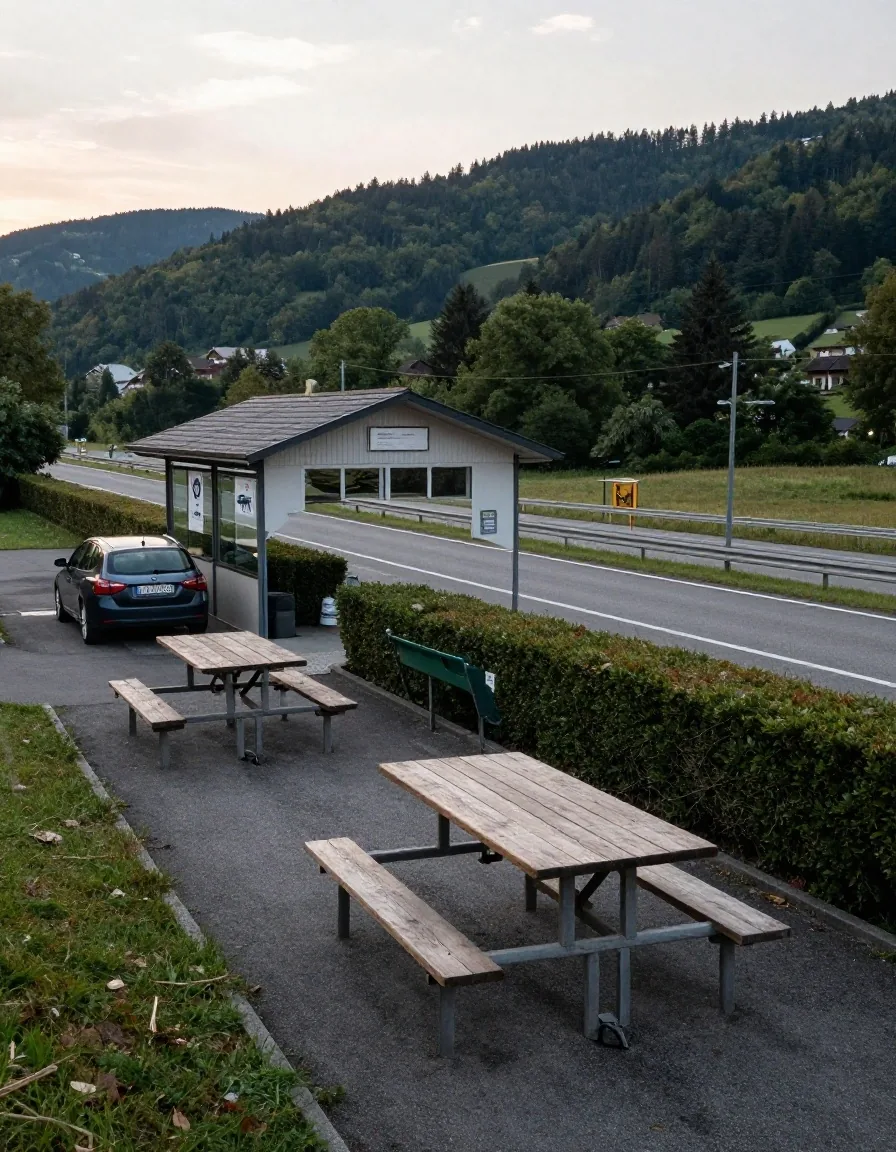
Service area on the corridor — no detour
Where stops belong in the plan
Stops are not an afterthought; they change the route. On a long Austrian drive, plan where you will refuel, eat and rest, and check that those places sit on your corridor rather than a detour off it.
Motorway service areas are convenient and priced accordingly; a town just off the motorway is often cheaper and a short break from the road. On mountain routes, stops are scarcer, so plan them before you climb. A stop you did not plan becomes a stress you did not need.
Mark two kinds of stops: the fixed one you will definitely take on a drive over three hours, and the optional one you can skip if the road is clear. Keep both on the same side of travel where possible, so leaving and rejoining cost minutes, not a new navigation search.
Reading the map for the roads that will slow you
A map shows distance, not effort. Learn to spot the features that slow an Austrian drive: tight alpine sections, tunnels with restrictions, town centres the road runs straight through, and junctions where two corridors merge.
Those are where your average speed drops and where a small delay can grow. If a route has several of them close together, treat the estimate as optimistic. This is the skill that separates a plan that survives contact with the road from one that collapses at the first hold-up.
- Look for hairpins and contour lines packed tight — climbing takes longer than the kilometres suggest.
- Watch where a fast road narrows through a town — traffic lights and parked cars reset your pace.
- Note merges of two corridors — one slowdown there affects every route that shares the asphalt.
Map reading check
If three slow features sit within a short stretch, add time before you promise arrival.
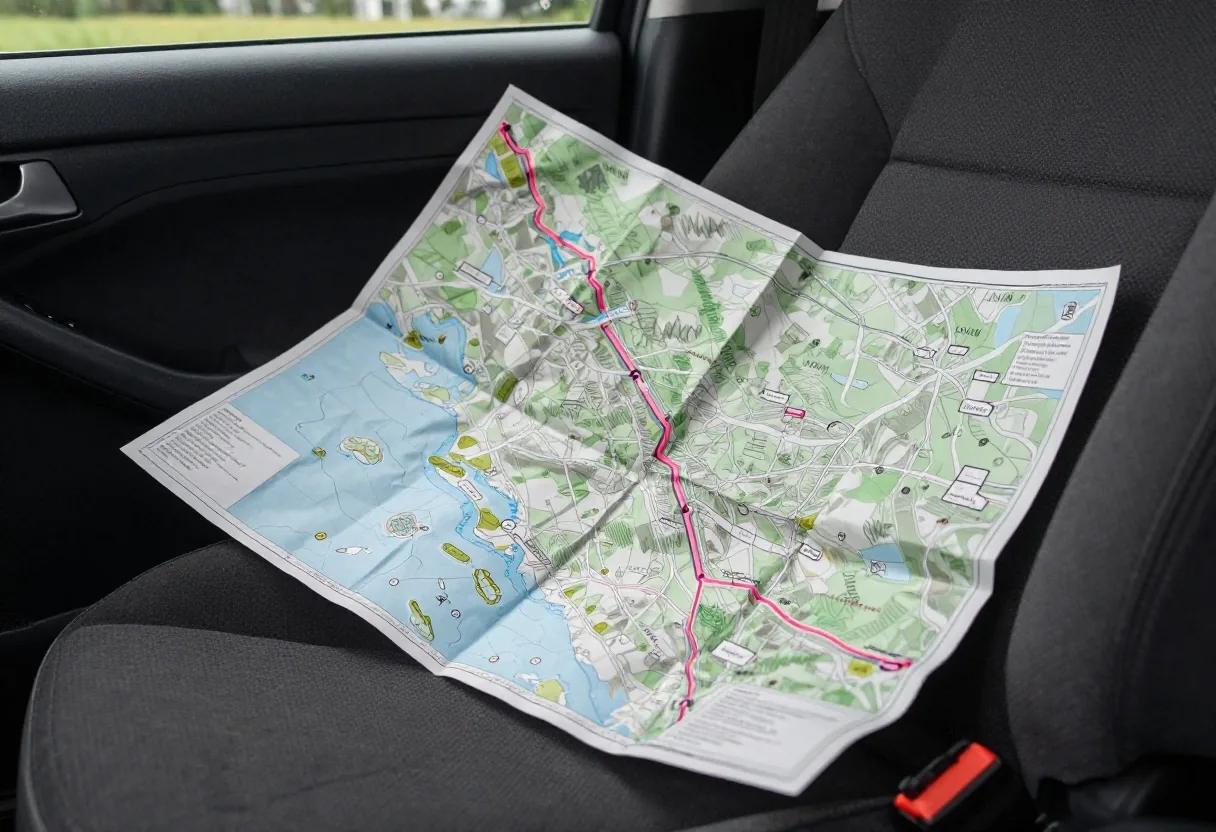
Planning a car route on paper still helps: the fold shows where decisions cluster.
A plan you can actually follow
Corridor, honest time, stops, and one backup — written so the next decision is always the easy one. Keep it short enough to read at a service area, not only at home.
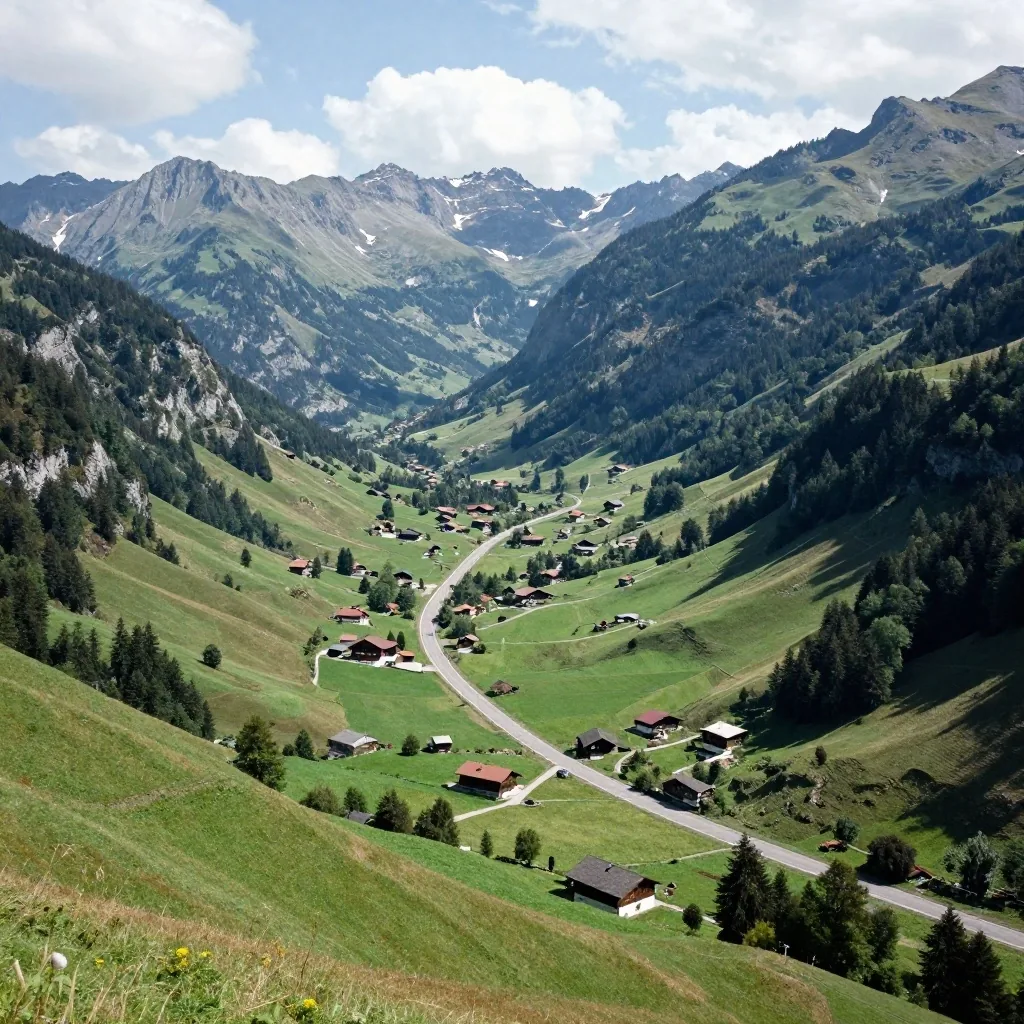
Valley line and fallback side by side
Building a backup route
Every serious plan has an alternative. Identify a second corridor or an ordinary-road fallback for the legs that matter most, and note where the two options diverge so you can switch without losing time.
On alpine routes, the backup is often the valley motorway when a pass is closed. On city approaches, it might be a different ring exit. You do not need a backup for every kilometre, only for the parts where a closure or heavy traffic would derail your day. Knowing it in advance turns a crisis into a lane change.
Where should the backup split off?
Mark the last junction where both options are still easy. If you pass it, you have committed — so say the name of that exit out loud when you plan.
How detailed should it be?
Three lines are enough: where you leave the main corridor, which towns you pass, and where you rejoin. A full turn list invites staring at a screen.
Rules before road
Checking constraints the map will not show
Maps do not display vignette obligations, seasonal closures, low-emission zones or vehicle restrictions. Those live in the rules, and they can decide whether your chosen road is even available to you.
Before you finalise a route, check the vignette and toll context, the seasonal status of any mountain road, and any city access rules on your approach. This is the step drivers skip when they are in a hurry, and it is the step that most often causes a problem. Five minutes of checking beats an hour of replanning at the roadside.
Five-minute check
- Vignette valid for every motorway day of the trip.
- Mountain road open for your dates and vehicle.
- City approach and parking allow your arrival hour.
Vigernette explains context in plain English. Confirm current rules with official sources before you leave.
Timing your departure around Austrian traffic
When you leave can matter as much as which route you take. Austria's motorway corridors carry commuter traffic around Vienna, Linz, Salzburg and Graz at the start and end of the working day, and holiday weekends load the main corridors in both directions.
Leaving an hour earlier or later can change the character of a drive entirely. If your schedule is flexible, treat departure time as a planning variable, not a fixed given. If it is not flexible, build the expected congestion into your estimate rather than hoping to avoid it.
For driving time in Austria, Friday afternoons southbound and Sunday evenings northbound deserve special care. A route planner that ignores the calendar will look right and drive wrong.
Putting the route into a form you can follow
Once the plan is sound, decide how you will follow it. A navigation app is fine, but enter the corridor choice deliberately so it does not send you down an ordinary road to save two minutes. Note the key junctions, the planned stops and the backup in a way you can read without staring at a screen.
For long drives, a short written list of the next two decisions is more useful than a detailed turn-by-turn you will never check. The plan exists to reduce decisions while driving, so keep it simple.
Where to continue
The method above gives you a corridor, an honest time, and a backup. These pages add the detail for each part of the drive.
Next reading
Corridors, tolls, and the checklist
Choices and help
Fastest or scenic — and a second view
Vigernette — Mariahilfer Straße 88, 1070 Wien · Monday to Friday, 9:00 AM – 6:00 PM